The Border Town Where Two Countries Gave Up Trying to Enforce an International Line
When Geography Becomes a Suggestion
Imagine walking into a library, checking out a book, and technically committing an international border crossing in the process. Welcome to Derby Line, Vermont, where the concept of national boundaries became so blurred that for more than 100 years, nobody really bothered to fix it.
This isn't a story about bureaucratic oversight or political tension. It's about what happens when human community trumps imaginary lines on a map, and two entire countries just... gave up trying to make sense of it.
The Town That Geography Forgot
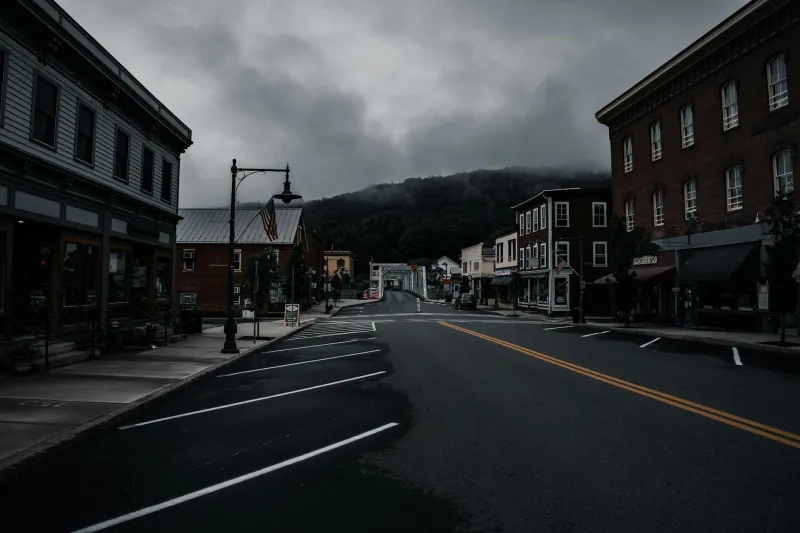
Derby Line sits so close to the Canadian border that calling it a "border town" feels like an understatement. The international boundary doesn't run around the town—it runs straight through it. Houses straddle the line. Streets cross back and forth between countries multiple times. The local opera house has its stage in Canada and its audience seating in the United States.
But the real kicker? For over a century, residents treated Canadian currency like it was perfectly normal American money.
Local businesses accepted Canadian dollars without batting an eye. Residents paid their bills, bought groceries, and conducted daily life using whatever currency happened to be in their pockets. The exchange rate? That was somebody else's problem. The international monetary system? A distant concern for people in Washington and Ottawa.
A Library That Defies Nations
The crown jewel of Derby Line's geographical confusion is the Haskell Free Library and Opera House. Built in 1904, this building embodies everything absurd about trying to enforce borders in a place where community matters more than nationality.
The library's entrance sits in Vermont, but walk toward the back stacks and you're suddenly in Canada. There's literally a black line painted on the floor marking where America ends and Canada begins. Patrons regularly cross this international boundary to return books, attend events, or simply browse the collection.
For decades, this created a bureaucratic nightmare that nobody wanted to solve. Technically, anyone entering the Canadian section should report to customs. Practically, that would mean customs agents stationed in a small-town library, processing paperwork for people checking out romance novels.
Both governments looked at this situation and essentially decided: "You know what? This is fine."
Commerce Without Borders
The currency situation grew even stranger over time. Local businesses developed their own informal exchange systems. Some shops posted daily rates. Others just accepted whatever you handed them and figured it out later. Canadian coins mixed freely with American quarters in cash registers.
Bank deposits became exercises in creative accounting. Residents would walk into Vermont banks with pockets full of Canadian money, and tellers would just... handle it. The banks dealt with the exchange complications behind the scenes, treating international currency conversion like a routine part of small-town banking.
This wasn't technically legal, but it wasn't exactly illegal either. The amounts were small, the community was tight-knit, and enforcing strict currency controls would have required more federal oversight than anyone wanted to deploy to a town of fewer than 1,000 people.
When Practicality Beats Policy
What made Derby Line's situation so remarkable wasn't just the currency confusion—it was how long everyone involved pretended it wasn't happening. Federal banking regulations clearly stated which currencies could be used where. International trade laws specified proper procedures for cross-border commerce.
Derby Line ignored all of it, and somehow, it worked.
Residents developed their own informal systems for everything. Mail delivery crossed borders multiple times per day. Emergency services responded to calls regardless of which country the emergency occurred in. Children walked to school through multiple jurisdictions without anyone tracking their movements.
The town essentially created its own micro-economy that operated independently of both American and Canadian monetary policy.
The Modern Reality
Today, increased border security has made Derby Line's freewheeling approach to international boundaries more complicated. Post-9/11 regulations require more documentation for border crossings. The informal currency exchanges have largely disappeared, replaced by more official banking procedures.
But the library still straddles the border. Residents still live in houses that technically exist in two countries. The opera house still hosts performances where the cast performs in one nation while the audience sits in another.
Derby Line remains a place where the abstract concept of national borders meets the concrete reality of human community—and community usually wins.
The Lesson Nobody Asked For
Derby Line's century-plus experiment in ignoring international boundaries reveals something profound about how artificial many of our organizational systems really are. When geography, community ties, and practical necessity collide with official policy, sometimes the policy just has to adapt.
Two nations essentially looked at this small Vermont town and decided that enforcing their respective rules would create more problems than it solved. The result was a community that operated for generations as if international borders were merely suggestions—and somehow made it work.
In a world increasingly focused on walls, barriers, and strict enforcement of boundaries, Derby Line stands as a reminder that sometimes the most sensible approach is to just let people figure it out for themselves.