When the Mail Goes Wrong, Countries Get Born
Imagine opening your mailbox to find a letter that accidentally creates a new nation. That's essentially what happened in 1836 when a U.S. government clerk addressed an official boundary survey document to the wrong postal jurisdiction, setting off a bureaucratic domino effect that would leave hundreds of families living in a legal limbo for the next twelve years.
The story begins with what should have been routine paperwork. Congress had commissioned a survey to settle a minor border dispute between Arkansas and Missouri—nothing unusual there. But when the survey results needed to be filed, a harried postal clerk in Washington D.C. made a seemingly innocent mistake: he sent the official documentation to the wrong territorial office.
The Great Bureaucratic Black Hole
Instead of reaching the proper Arkansas territorial government, the survey papers landed on the desk of a confused Missouri official who promptly filed them away, assuming they belonged to someone else's jurisdiction. Meanwhile, Arkansas officials waited for documentation that would never arrive, eventually assuming the federal government had simply forgotten about their little corner of the world.
This wasn't just a filing error—it was a constitutional crisis in slow motion. The survey had been meant to establish which state would claim a 50-square-mile strip of land along the Current River, home to about 300 families who suddenly found themselves citizens of nowhere.
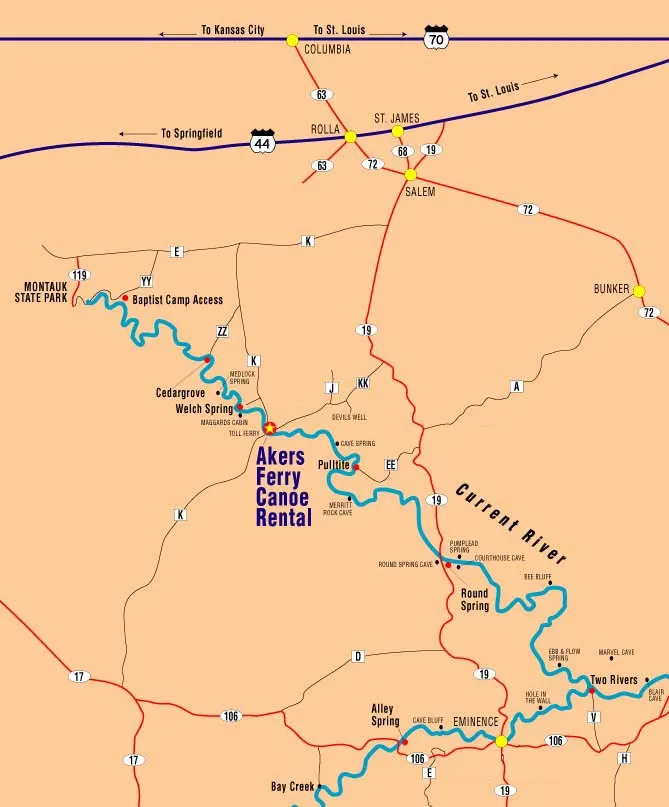 Photo: Current River, via www.currentrivercanoe.com
Without official state jurisdiction, the area became what legal scholars would later call a "sovereignty vacuum." The residents couldn't vote in state elections because neither Arkansas nor Missouri claimed them. They couldn't pay state taxes because there was no state to pay them to. Local law enforcement had no clear authority, and federal officials weren't sure which state's laws applied.
Life in Legal Limbo
For the families living in this accidental republic, daily life became surprisingly manageable. Without state oversight, they formed their own informal governance system, electing a council of local leaders who made decisions about everything from road maintenance to settling disputes. They essentially became a functioning micro-democracy by necessity.
The lack of official taxation meant residents kept more of their income, which they used to build better infrastructure than many neighboring communities. Without state regulations, local businesses operated with remarkable freedom, creating a small but thriving economy based on lumber, farming, and river trade.
Some residents began jokingly referring to their territory as the "Free State of Current River," complete with its own unofficial flag—a piece of cloth with a question mark sewn onto it that flew over their makeshift courthouse.
When Washington Finally Noticed
The federal government remained blissfully unaware of the situation until 1848, when a census taker trying to count residents for the upcoming presidential election discovered an entire population that couldn't legally vote. The census worker's report triggered a frantic search through government files, eventually uncovering the misfiled survey documents that had started the whole mess.
By this time, the residents had grown rather fond of their independence. When Missouri and Arkansas both suddenly showed up claiming jurisdiction—and demanding twelve years of back taxes—the locals politely declined. They'd been governing themselves just fine, thank you very much, and saw no reason to change.
Congress Steps In
The situation required congressional intervention to resolve. In 1849, lawmakers passed a special act officially assigning the territory to Missouri while acknowledging that residents owed no back taxes to either state. The legislation included an unusual provision allowing anyone who preferred Arkansas citizenship to relocate there at federal expense—an offer that exactly zero residents accepted.
The "Free State of Current River" was quietly absorbed into Missouri, its brief existence as America's most accidental republic ending with little fanfare. Most residents adapted quickly to their new official status, though local historians note that the area maintained an unusually independent political culture for decades afterward.
The Lesson in the Mail
This bizarre episode highlights how much of government authority depends on paperwork being filed correctly. A single misdirected letter created a constitutional anomaly that lasted over a decade, proving that sometimes the most profound political changes happen not through revolution or legislation, but through simple human error.
Today, the former "Free State of Current River" is just another part of rural Missouri, but its courthouse still displays a replica of that question mark flag as a reminder of the time when a postal mistake accidentally invented a country that actually worked pretty well.