The Stickiest Failure in Science
Dr. Harry Coover was having the worst day of his research career. It was 1942, and he was working for Eastman Kodak, desperately trying to develop clear plastic gun sights for American fighter planes. Instead, he'd created something that stuck to everything it touched—his equipment, his tools, even his fingers.
 Photo: Eastman Kodak, via www.marketbeat.com
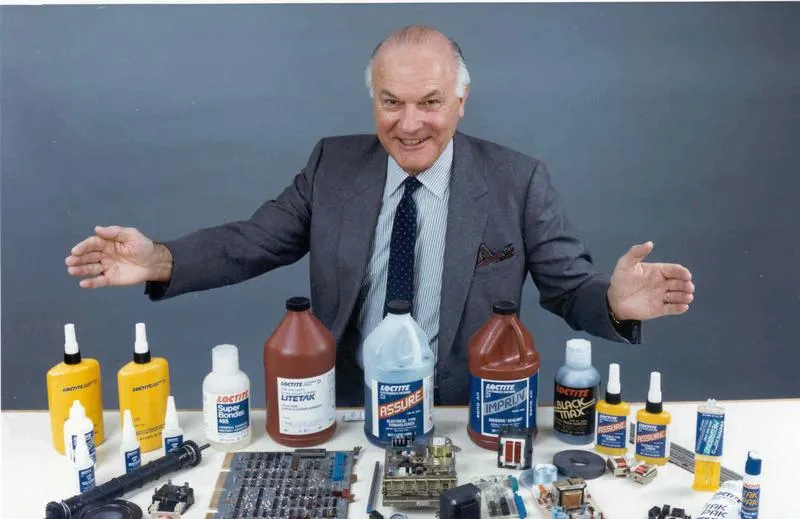 Photo: Dr. Harry Coover, via nationalmedals.org
Every time Coover thought he'd made progress, his new compound would glue his instruments together, ruin his measurements, and generally make his life miserable. He couldn't get it off anything, couldn't control it, and couldn't figure out how to make it useful. So he did what any frustrated scientist would do: he labeled it a failure and moved on to other projects.
What Coover didn't know was that he'd just invented one of the most important medical tools of the 20th century.
From Weapons to Band-Aids
Coover's sticky disaster sat on a shelf for nearly a decade before he encountered it again. In 1951, he was working on heat-resistant jet canopies when he rediscovered his old nemesis. This time, instead of cursing its impossible adhesiveness, he started thinking about what you could actually do with something that stuck so permanently to everything.
He and his colleague Fred Joyner began experimenting with the compound they now called "cyanoacrylate." They discovered it could bond almost any material to almost any other material in seconds, without heat, pressure, or special preparation. It was like nature's perfect glue—if you could handle the fact that it would also glue your fingers together if you weren't careful.
Eastman Kodak started marketing it as "Super Glue" in 1958, positioning it as a household adhesive for quick repairs. The company had no idea they were selling what would become a life-saving medical device.
The Medic Who Connected the Dots
The breakthrough came during the Vietnam War, when military medics were struggling with battlefield injuries that were too severe for traditional bandages but not severe enough for major surgery. Dr. Harry Coover Jr. (the inventor's son, who had followed his father into medicine) heard about field medics using Super Glue to seal wounds when conventional methods weren't working.
 Photo: Vietnam War, via wallpapers.com
The logic was simple but revolutionary: if Super Glue could bond metal to metal and plastic to plastic instantly, why couldn't it bond skin to skin? The cyanoacrylate would create an immediate seal over cuts, stopping bleeding and protecting the wound from infection until proper medical treatment could be administered.
Initial tests were promising enough that military medical units started carrying Super Glue as standard equipment. Medics found they could seal lacerations, close surgical incisions, and even repair minor internal injuries with a few drops of the same stuff people were using to fix broken coffee mugs.
From Battlefield to Emergency Room
Word of Super Glue's medical applications spread quickly through the medical community. Emergency room doctors started experimenting with it for civilian trauma cases. Pediatric surgeons found it perfect for treating children who were too young to sit still for traditional sutures. Plastic surgeons discovered it left minimal scarring compared to stitches.
The compound had several advantages over traditional wound closure methods: it was faster than stitches, didn't require removal, was naturally antibacterial, and created a waterproof seal. For certain types of injuries, it was simply superior to anything else available.
By the 1970s, medical-grade cyanoacrylate was being used in hospitals across America. The same substance that had frustrated Dr. Coover for ruining his lab equipment was now saving lives in emergency rooms, operating theaters, and ambulances.
The Science of Accidental Genius
What makes this story remarkable isn't just that Super Glue became a medical tool—it's how perfectly suited it was for that purpose from the very beginning. Cyanoacrylate polymerizes (hardens) in the presence of water, which means it activates when it contacts blood or other bodily fluids. It's naturally sterile and creates a barrier that prevents bacterial infection.
In other words, all the properties that made it "useless" as a plastic adhesive made it ideal as a medical adhesive. Dr. Coover had accidentally created the perfect wound sealant while trying to make something completely different.
The Modern Legacy
Today, medical-grade cyanoacrylate is standard equipment in emergency rooms, ambulances, and military medical kits worldwide. It's estimated that Super Glue-based wound closures have saved thousands of lives and prevented countless infections since its medical applications were discovered.
The compound has evolved into specialized medical formulations that are designed specifically for human tissue. Some versions are flexible enough to move with the skin, others are designed to dissolve harmlessly after the wound heals, and still others are formulated to work in wet conditions like inside the mouth or around eyes.
Dr. Coover, who died in 2011 at age 94, lived to see his "failed" experiment become one of the most important medical innovations of his lifetime. He often joked that he'd spent more time trying to get his invention off his fingers than he had developing it in the first place.
The Lesson in the Glue
The story of Super Glue's journey from laboratory nuisance to medical miracle illustrates something profound about innovation: breakthrough discoveries often come from embracing failure rather than avoiding it. Dr. Coover's willingness to revisit his "mistake" years later led to applications he never could have imagined.
It's also a reminder that the most transformative inventions often solve problems their creators never intended to address. Coover was trying to help win a war by improving gun sights. Instead, he ended up helping save lives by improving emergency medicine.
Sometimes the best discoveries are the ones that happen when we're trying to discover something else entirely. The next time something goes wrong in your day, remember Dr. Coover's sticky disaster—you might be looking at tomorrow's breakthrough without realizing it.