A Reporter Made Up the Cow Story. Chicago Believed It for 126 Years Anyway.
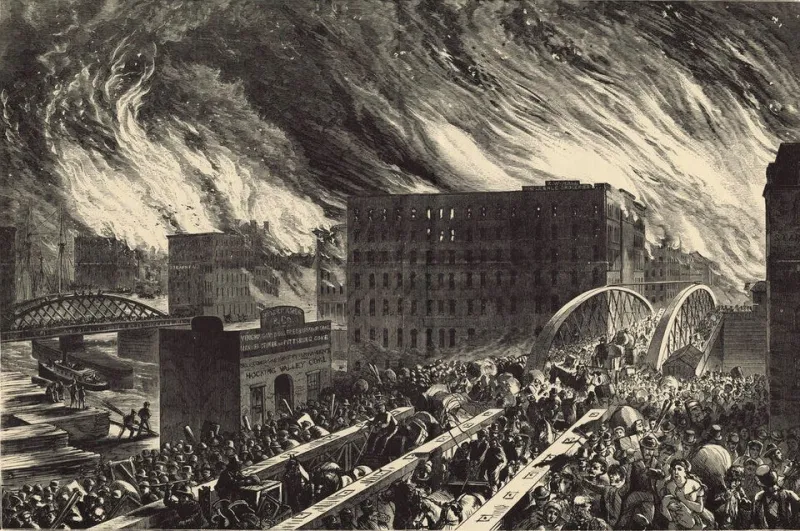
Photo: John R. Chapin, died 1907, Public domain, via Wikimedia Commons
On the night of October 8, 1871, a fire broke out in a barn on DeKoven Street on Chicago's West Side. Within hours, it had consumed entire city blocks. By the time it burned itself out two days later, the Great Chicago Fire had killed an estimated 300 people, left 100,000 residents homeless, and reduced roughly four square miles of the city to ash and rubble.
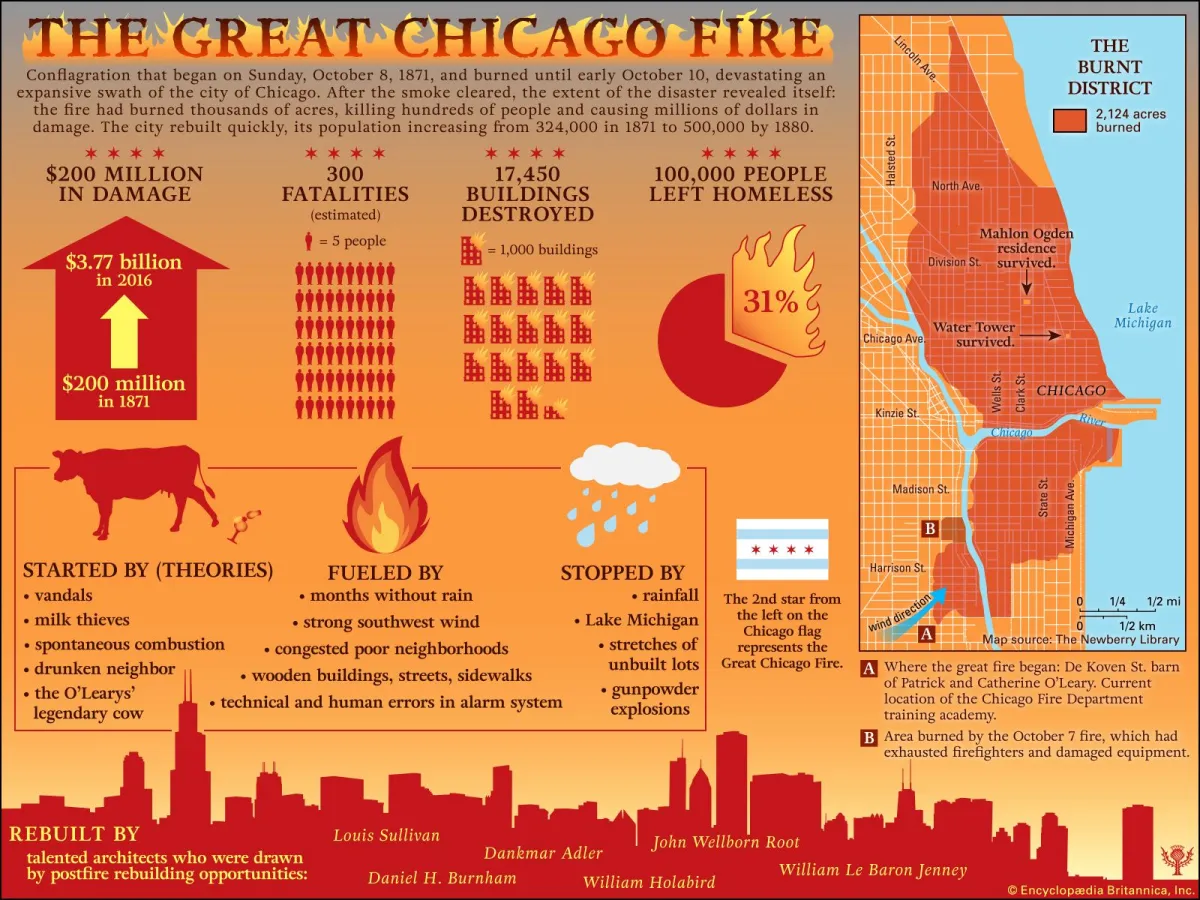 Photo: Great Chicago Fire, via cdn.britannica.com
America needed someone to blame. It found a cow.
How a Barn Fire Became a Legend
The story spread almost as fast as the flames themselves: a woman named Catherine O'Leary had been milking her cow late at night, the cow kicked over a lantern, and that lantern set the barn ablaze. Within days, newspapers across the country had printed the tale as established fact. Mrs. O'Leary and her rebellious cow became one of the most enduring origin stories in American history — taught in schools, referenced in songs, printed on postcards, repeated in encyclopedias.
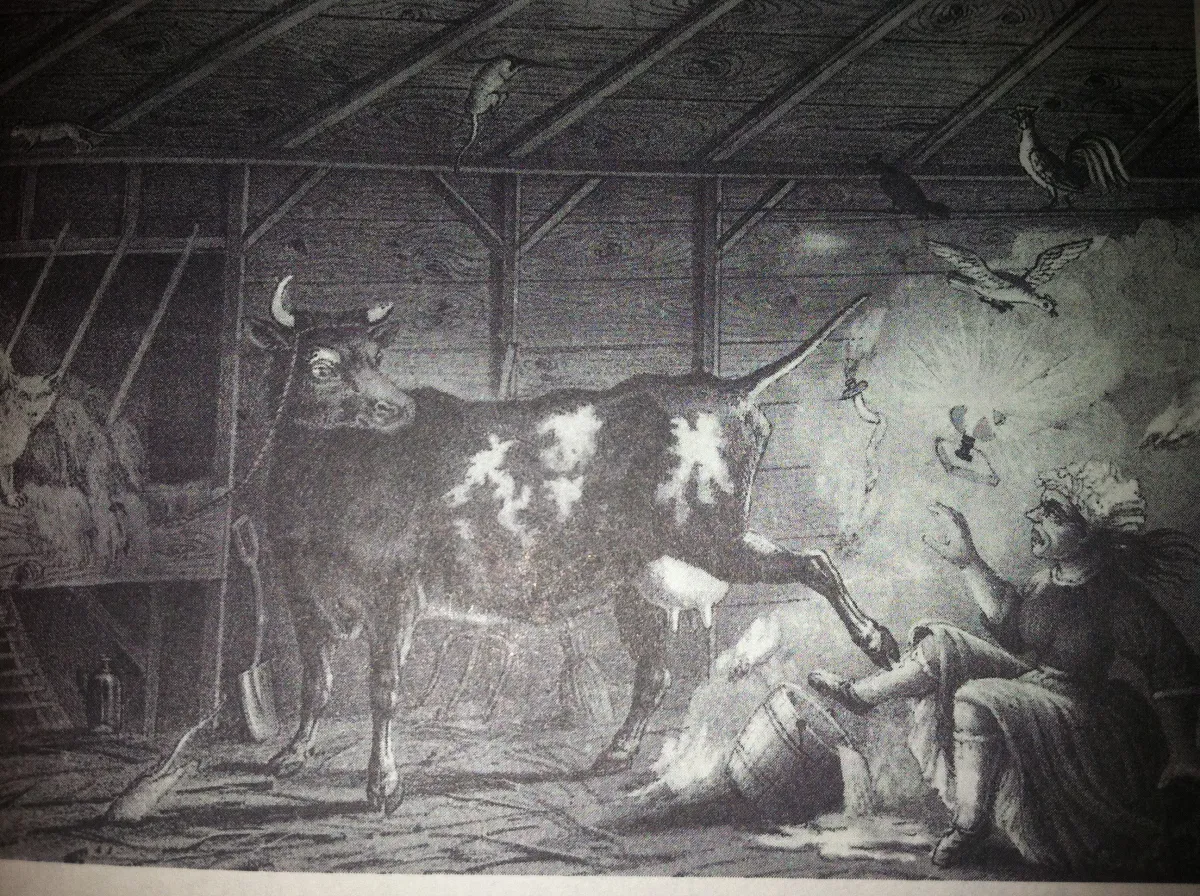 Photo: Catherine O'Leary, via blogs.smithsonianmag.com
There was just one problem. A Chicago Tribune reporter named Michael Ahern made the whole thing up.
Ahern admitted as much in 1893 — more than two decades after the fire — telling colleagues he had fabricated the cow-and-lantern detail to make his story more colorful. He wasn't hiding it. He said it plainly. And yet somehow, the myth kept going.
The Woman Who Spent the Rest of Her Life Running
Catherine O'Leary never recovered from the story. She became a national punchline and a local scapegoat almost overnight. Crowds gathered outside her home. She was mocked in cartoons, lampooned in songs, and blamed in editorials. A city that had itself been built largely on wooden structures with minimal fire codes — a disaster waiting to happen by almost any engineering standard — pinned its catastrophe on one Irish immigrant woman and her cow.
O'Leary largely withdrew from public life. She refused interviews, avoided crowds, and by most accounts spent her remaining years trying to simply disappear. She died in 1895, still carrying the weight of a story that wasn't true.
The official investigation conducted after the fire never actually concluded she was responsible. The inquiry was chaotic, the testimony contradictory, and the final report inconclusive. But inconclusive doesn't make for a good headline. A cow kicking over a lantern does.
The Myth That Refused to Die
What makes the O'Leary story genuinely remarkable isn't that a reporter invented it — journalists have been embellishing stories since the printing press. What's remarkable is how thoroughly the lie outlasted the correction.
Ahern's admission in 1893 barely registered. The cow story kept appearing in textbooks well into the twentieth century. It showed up in popular films, history books, and school curricula for generations after the man who invented it had publicly said he invented it. Chicago even named a street near the site after O'Leary — not as a tribute, but as a kind of permanent reminder of her alleged guilt.
By the time the twentieth century rolled around, the cow had achieved something close to mythological status. It wasn't just a story about a fire anymore. It was a founding fable, a piece of civic identity, a shorthand for the city's dramatic origin. Chicago had grown so attached to the narrative that the truth had become almost beside the point.
126 Years Later, a Formal Apology
In 1997, a Chicago alderman named Edward Burke introduced a resolution to the City Council formally exonerating both Catherine O'Leary and her cow. The resolution passed. One hundred and twenty-six years after the fire, Chicago officially acknowledged that the whole story had been a fabrication.
The gesture was largely symbolic, of course. O'Leary had been dead for over a century. The cow had presumably been dead even longer. But the resolution did something important: it put the correction on the record in the same official way the accusation had once been treated as record.
Burke noted at the time that the exoneration was long overdue — that a woman had spent the last years of her life in shame over something a reporter invented to sell papers, and that the city had spent over a century repeating the lie without pausing to question it.
What the Cow Really Tells Us
The actual cause of the Great Chicago Fire remains officially undetermined. Several theories have circulated over the years — a neighbor named Daniel Sullivan, who was among the first to report the fire, has been suggested as a more plausible candidate. Others have pointed to a group of men gambling in the barn that night. None of these theories have been conclusively proven.
But here's the thing about the O'Leary myth that makes it worth revisiting: it's not really a story about a fire. It's a story about how quickly a convenient narrative can harden into accepted history, and how stubbornly that history resists correction even when the person who invented it stands up and says so.
The cow didn't burn down Chicago. A city built like a tinderbox, with wooden sidewalks and closely packed timber structures and fire departments stretched thin, burned down Chicago. But that story doesn't have a villain you can draw in a cartoon.
A cow does.
And sometimes, that's all it takes.