Washington Printed Counterfeit Money — And Then Had to Spend It Anyway
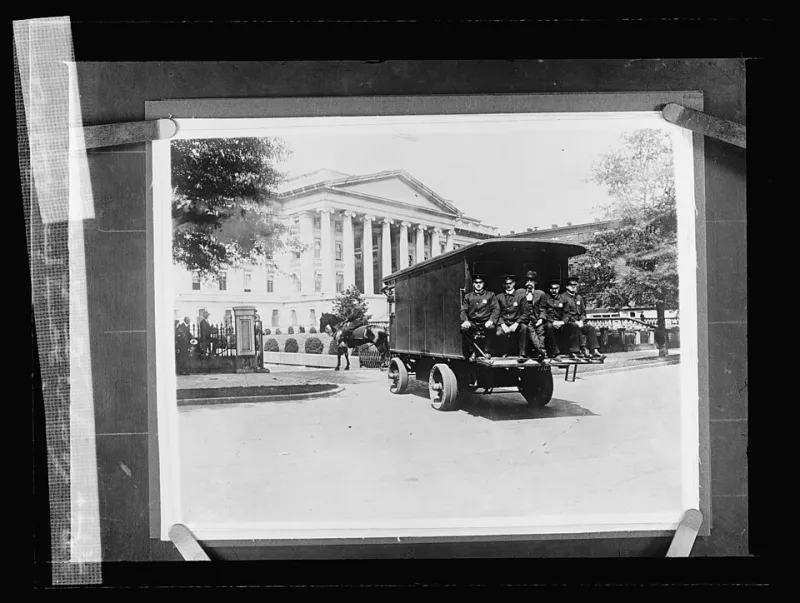
Photo: National Photo Company Collection, Public domain, via Wikimedia Commons
There is an old joke that the only difference between a counterfeiter and the Federal Reserve is a printing press and a law degree. As it turns out, that joke is funnier than most people realize — because at least once in American history, the U.S. Treasury printed money that its own laws classified as fake, shrugged, and put it into circulation anyway.
 Photo: Federal Reserve, via news.wttw.com
This is not a conspiracy theory. It is a bureaucratic disaster so perfectly absurd that it could only have happened in Washington.
How You Accidentally Counterfeit Your Own Money
To understand the blunder, you need to understand how tightly regulated currency production actually is. Every denomination of U.S. paper money must meet an extraordinarily specific set of printing standards — precise ink weights, serial number formatting, plate registration tolerances, and security feature placements that are defined not just by internal Treasury policy but by codified federal law. The standards exist, obviously, to make counterfeiting hard. The cruel irony is that they also make accidental counterfeiting by the government itself entirely possible.
In the mid-20th century, the Bureau of Engraving and Printing — the Treasury agency responsible for physically producing American currency — ran into exactly this problem. A production run of bills left the presses with a combination of errors significant enough that, measured against the technical legal definitions written into federal counterfeiting statutes, the notes did not fully conform to what the law described as legitimate legal tender. The errors were not cosmetic. They involved elements of the bills that the law specifically identified as distinguishing features of authentic currency.
 Photo: Bureau of Engraving and Printing, via upload.wikimedia.org
In other words, Washington had printed money that Washington's own laws said wasn't real money.
The Legal Paradox Nobody Wanted to Talk About
The moment Treasury lawyers understood what had happened, the situation became almost comically complicated. Destroying the bills was one option, but production runs of that scale represent enormous costs — the paper, the ink, the press time, and the labor don't come cheap when you're printing millions of notes. More importantly, some of the bills had already moved through the early stages of distribution, making a clean recall difficult to execute quietly.
The quietness mattered enormously. The last thing the Treasury Department wanted was a public announcement that it had accidentally counterfeited its own currency. The effect on public confidence in American money — already a fragile psychological construct held together largely by collective agreement — could have been genuinely damaging. If people started asking whether their dollars were real dollars, the answer, technically, was complicated.
So instead of a transparent public recall, the government did what governments do best: it lawyered its way out of the problem. Treasury legal teams worked to establish that the errors, while technically disqualifying under a strict reading of existing statutes, fell within an interpretive gray zone that allowed the bills to be treated as valid. It was the kind of legal gymnastics that requires a very straight face and a very expensive suit.
The argument, stripped of its bureaucratic language, was essentially this: the intent behind the printing was legitimate, the issuing authority was legitimate, and therefore the notes should be considered legitimate regardless of what the technical specifications said. Courts have historically been sympathetic to arguments about intent when the alternative is declaring millions of dollars in government-issued currency to be legally worthless.
Fixing the Rules So the Rules Fit the Mistake
But winning a legal argument in the short term wasn't enough. The deeper problem was that the statutes themselves were written in a way that created this trap, and as long as those statutes existed unchanged, the trap could spring again. So alongside the quiet legal maneuvering to validate the already-circulated bills, Treasury pushed for regulatory and procedural updates that tightened the production standards and adjusted the legal language describing what constituted authentic currency.
The revisions were framed publicly as routine modernization — a standard update to keep currency law current with evolving printing technology. Which was technically true. It just conveniently also happened to close the specific loophole that had briefly made the U.S. government the most prolific counterfeiter in the country.
The Absurdity at the Heart of It
What makes this story genuinely remarkable isn't the printing error itself. Machines make mistakes. What's remarkable is the chain of consequences that followed: a government agency accidentally broke the law it was designed to enforce, then used legal interpretation to retroactively make its lawbreaking lawful, then quietly rewrote the law to ensure nobody could ever point to the original problem again.
It is, in miniature, a perfect portrait of how large institutions handle embarrassing failures. Not with transparency. Not with accountability. With paperwork.
The bills in question almost certainly passed through thousands of American wallets without anyone knowing they were, for a brief and legally awkward moment, technically counterfeit. People bought groceries with them. Paid rent. Tipped waitstaff. The money worked exactly the way money is supposed to work, which is the final irony — because money, at its core, is just a shared agreement that a piece of paper means something.
And apparently, even when the government accidentally breaks its own rules about what that paper is supposed to look like, the agreement holds.
Benjamin Franklin, whose face graces the hundred-dollar bill, once wrote that nothing in life is certain except death and taxes. He might have added: and the government's remarkable ability to make its own mistakes disappear into the fine print.
 Photo: Benjamin Franklin, via www.cultura10.com