The Victorian Inventor Who Faked His Own Death So Well His Sons Cashed the Insurance Check — Twice
There's a specific kind of audacity that belongs exclusively to the Victorian era — the kind that lets a man disappear off the face of the earth, let his own family grieve him, watch them collect his life insurance, and then just... keep living. Quietly. Prosperously. Under a different name.
William Cantelo pulled this off so thoroughly that even after his sons had him legally declared dead and cashed the payout, the universe kept sending them postcards from beyond the grave in the form of witnesses who swore they'd seen the old man, very much alive, very much busy inventing things.
 Photo: William Cantelo, via spiderimg.amarujala.com
And then the insurance company paid out again.
This actually happened.
Who Was William Cantelo?
In the 1870s and early 1880s, William Cantelo was a respectable, if eccentric, inventor and businessman operating out of Southampton, England. He was the kind of man who filled notebooks with mechanical sketches and spent long evenings in his workshop tinkering with ideas that were either brilliant or completely useless — sometimes both. His particular obsession during his final documented years was a rapid-fire gun mechanism, a project he pursued with the secretive intensity of someone who genuinely believed he was sitting on a fortune.
He told almost nobody the details. He kept the workshop locked. He was, by all family accounts, becoming increasingly consumed by the project.
And then, sometime in the mid-1880s, he simply wasn't there anymore.
No note. No argument. No body. William Cantelo walked out of his life in Southampton and didn't walk back in.
The Legal Machinery of Disappearance
In Victorian England, declaring someone legally dead was not a quick or casual process, but it was a navigable one — particularly when the missing person had left behind no evidence of foul play and no trail suggesting they'd simply relocated. Cantelo's sons waited the requisite period, gathered statements from neighbors and associates confirming he hadn't been seen, and eventually convinced a probate court that their father was, in all reasonable likelihood, deceased.
The life insurance policy paid out. The estate was settled. The sons grieved, moved on, and tried to forget about the locked workshop and the gun project their father had never explained.
Except the witnesses wouldn't cooperate.
Over the following years — and this is the part that sounds like a Victorian penny novel but is documented in contemporary accounts — multiple credible individuals reported seeing a man who was unmistakably William Cantelo. Not a vague resemblance. Not a trick of the light. People who had known him well, who had done business with him, who recognized his particular way of moving through the world, kept swearing they'd encountered him alive and apparently flourishing.
The name attached to these sightings? Hiram Stevens Maxim. An American inventor who had arrived in Europe in the early 1880s and promptly produced one of the most consequential weapons in military history: the Maxim Gun, the world's first fully automatic machine gun.
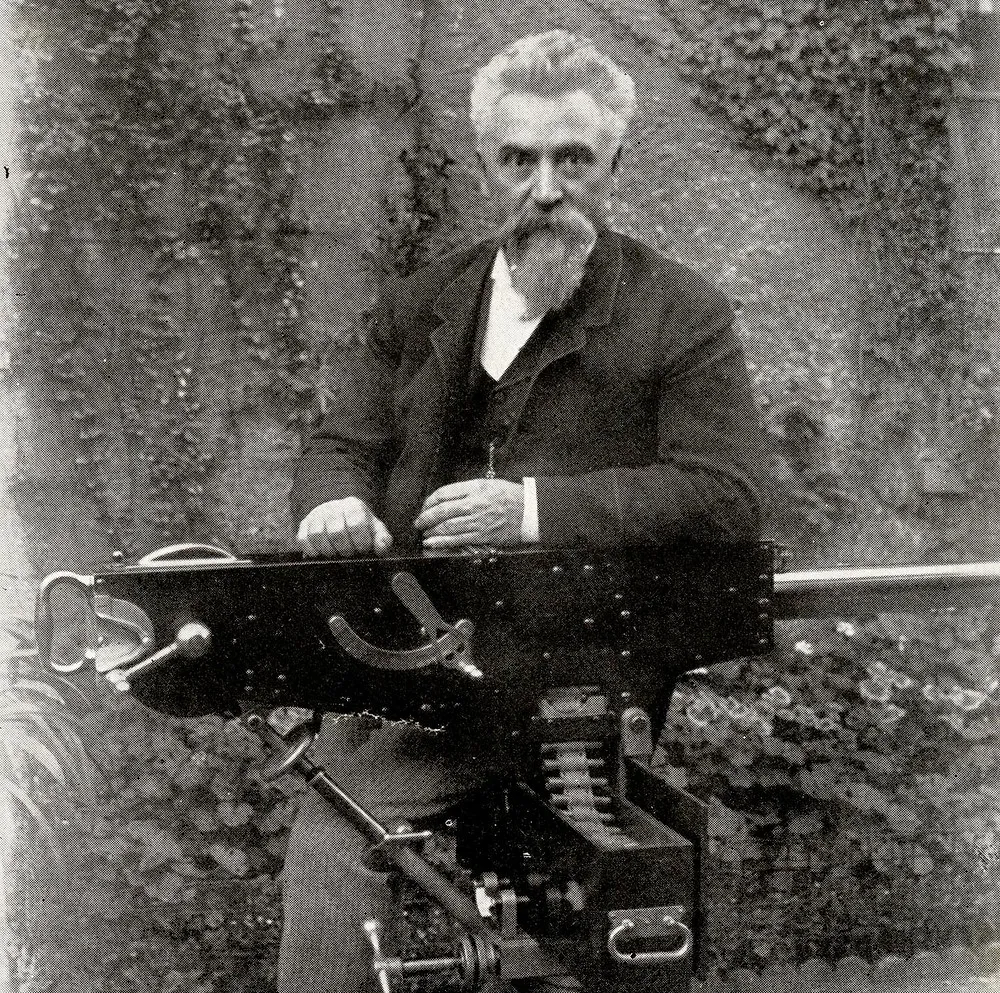 Photo: Hiram Stevens Maxim, via static.wixstatic.com
The Uncomfortable Coincidence
Cantelo's sons were not subtle about their suspicions. They tracked down Maxim, studied photographs, and became convinced — genuinely, deeply convinced — that Hiram Maxim and their missing father were the same person. The physical resemblance was striking. The timing of Maxim's appearance in Europe aligned neatly with Cantelo's disappearance. And then there was the gun.
Cantelo had been obsessively developing a rapid-fire weapon mechanism in a locked Southampton workshop. Maxim had emerged from relative obscurity to produce a revolutionary automatic firearm that made him wealthy, famous, and eventually knighted by Queen Victoria.
The sons never proved it. Maxim, for his part, was an established figure with an American background, documented history, and no particular reason to engage with the accusations of two grieving Englishmen. The courts were not interested. The probate system, having already declared Cantelo dead, was institutionally committed to that position.
But here's where the story tips from strange into genuinely absurd: the sightings continued. New witnesses. New locations. A man matching Cantelo's description, doing Cantelo-adjacent things, refusing to be conveniently dead.
The Second Payout
The lax record-keeping of the era, combined with the bureaucratic inertia of Victorian insurance administration, created a situation that modern actuaries would find physically painful to contemplate. With the original death declaration standing, with no legal mechanism to reverse it based on unverified witness accounts, and with the insurance company facing the choice between a messy public dispute and a quiet settlement, the policy paid out a second time.
Not loudly. Not with any admission that the system had been comprehensively outwitted. Just quietly, the way institutions handle embarrassments they'd rather not examine too closely.
Whether William Cantelo and Hiram Maxim were actually the same person remains, technically, unproven. Maxim lived until 1916, dying at age 76. Cantelo, had he survived, would have been in his nineties by then — which is where the "lived to 94" figure in family oral history originates, though the documentation is, predictably, murky.
Why This Story Is Remarkable
What makes the Cantelo case genuinely fascinating isn't the conspiracy theory angle — it's what the story reveals about the gaps in systems we assume are airtight. Victorian probate courts declared people dead based on absence and testimony. Insurance companies paid claims based on court orders. Neither system had a reliable mechanism for handling the possibility that the deceased had simply gotten very good at being somewhere else.
One man's talent for reinvention — whether that man was Cantelo, Maxim, or both — exposed every assumption buried inside those systems simultaneously.
And the insurance company paid. Twice. Because the alternative was admitting that a Victorian tinkerer from Southampton had beaten them so thoroughly that the only dignified response was to write the check and never speak of it again.
There's something almost admirable about that. Almost.